Interviewers ask hundreds of questions, but they actually listen for a handful of things.
Skip the memorizing. In 14 days, 15 minutes a day, you develop an ear for what the interviewer is actually asking, and a shape for answering it on the spot, with your own strongest stories.
Tell me about a time you disagreed with a stakeholder.
How do you handle pushback on your design?
Describe a conflict with a product partner.
Tell me about a hard decision you made.
Walk me through your process.
Tell me about a time you had incomplete information.
What’s your biggest weakness?
Tell me about a time you failed.
What feedback has stuck with you?
A solid candidate gets a question they should have nailed. They start well, then wonder whether they're answering what was asked, and start adding detail. The next answer comes out long and generic, the one after that purely chronological, or too tactical for the role.
It almost never comes down to experience. Nobody showed them what the panel is listening for.
Strong start, then a doubt
Extra detail, just in case
Purely chronological
Too tactical for the role
On day 1 you record your answer to “tell me about yourself” the way you’d give it today. Then come all the reps in between, one question a day. On day 14 you answer that first question again, and play the two back to back.
Tell me about yourself.
20+ years in UX leadership, most recently VP of UX at JPMorgan Chase. I've interviewed and hired designers and design leaders, and coached thousands more through their own loops. What I know is how a panel decides, which is the part candidates never get to see.
Just building your interview muscle memory. Every morning for 14 days, a new lesson opens on your private dashboard.
One printable page: the handful of things panels test, and the common questions that test each one. So a question you've never heard still has a familiar shape.
Tell me about yourself.→The pattern behind your history
Walk me through your process.→Whether you think like a leader or an IC
What would you do in your first 90 days?→How you learn and prioritize
Why are you leaving?→How you’ll talk about this company one day
The goal is to kill interview anxiety and build confidence in yourself, through understanding the question patterns and repeated practice. The more reps you put in, the more natural the right shape will feel.
You walk in steady, knowing what's coming, even when the wording surprises you.
You hear the question underneath, and you know what to look for in your own answer.
Your own experiences, shaped for the questions leadership panels ask, in your own words.
Every answer you recorded, and the feedback you chose to ask for. Proof of how far you've come.
Five extras, so the practice sticks long after day 14.
One for every question, filled in with your own stories.
includedBy day 14, your worksheets add up to your own stories, shaped and ready.
includedOne page to collect the stories every leadership interview draws from, so the right one is ready when you need it.
includedShare a recording in the private community for feedback, if and when you want it.
included
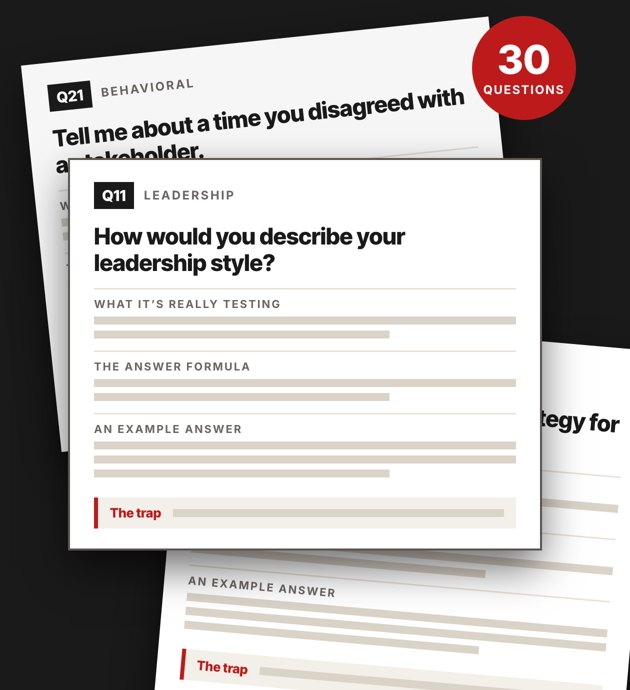
The 30 questions panels ask director candidates, what each one is testing, and an answer formula with an example for every one of them.
A few of the questions from the bootcamp, answered on my Instagram. Tap a reel for sound.
For more than 20 years I sat on the hiring side, most recently as VP of UX at JPMorgan Chase. Again and again, I watched strong designers lose a leadership role in the interview, when everything they needed to win it was already in their own stories.
So I built the practice I wished they'd had: 15 minutes a day with the questions panels actually ask, until you hear what each one is testing and answer in your own words.
Today I coach experienced designers through the jump into leadership. Some of my past clients now lead teams at Amazon, Meta, Spotify and Google.
I also write UX Mentor Diaries, a Top 25 Substack in Design, about how power actually works inside organizations.
Marina helped me get interview-ready, coaching me on how to authentically tell my story and handle the tough ‘why the switch?’ questions.
Coaching client, Design Leader at a global investment bank
There was no generic advice. Marina gave sharp insights and frameworks I could apply right away.
Coaching client, Design Leader at a global productivity app
I have worked with several coaches and Marina is the first to really cut to the chase.
Coaching client, Lead Product Designer at a Big Tech company
Marina put so much work in, to figure me out professionally and to see things about me that I could not see in myself.
Coaching client, Lead UX Architect at a UK engineering institution
Marina’s encouragement and swift support rebuilt my confidence during challenging times and fueled my career progress.
Coaching client, Design Leader at a consumer tech company
Marina helped me get to the root of my problem and showed me the direction I needed to take.
Coaching client, UX Strategist at a startup
What you'll have is an ear for every question, stories that fit, and the steadiness to answer as yourself.
14 daily lessons, about 15 minutes each. Every day comes with a worksheet and a recording of your own answer.
Not yet. Join the waitlist, and you’ll be the first to know.
No. They're yours. Sharing them in the community is optional.
Both, as long as you're going for a leadership role.
The waitlist hears first.
Feeling like yourself on a good day, sure the people across the table are meeting the leader you actually are.
The right answer to your hardest interview question already exists in your own experience. The bootcamp teaches you to find it while you're still in the room.